Google Ads · Platform change
AI Max auto-upgrade, September 2026
Since 1 September 2026, Google has been upgrading Search campaigns using campaign-level broad match or standalone automatically created assets to AI Max. It is not a single day. The job runs across the whole month, campaign by campaign. Some of your campaigns have already been through it, and the record of which ones starts expiring on 1 October.
You did not choose this one.
Right now, campaigns you have not touched are starting to behave differently. Google migrates them in place. Your account records no decision, because you did not make one.
Every write-up of this gave you the same date and the same advice: get familiar with AI Max before it arrives. Fine advice. It is not the part that will cost you.
The part that will cost you is losing the ability to say what your account looked like before.
Something already happened, quietly
And something already happened, quietly, before the email landed. On 3 August, Google switched off creation of both legacy settings across the interface, Google Ads Editor and every version of the API. The notification emails went out on 5 August.
By the time you were told, the list of campaigns this affects was closed.
That closed list is worth a minute of your time. The set can only shrink from here, and nothing you do can add a campaign to it. So the inventory you take today is the largest that list will ever be.
That inventory also gets harder to take every week that passes. Once a campaign has been migrated, its current configuration says AI Max, not what it was carrying in August.
Or see what your team should look at first: the Paid Media Capacity Check, being built nowWhat is being upgraded, and when?
Two settings, on Search campaigns only. Campaign-level broad match and standalone automatically created assets migrate to AI Max between 1 and 30 September 2026. Dynamic Search Ads were moved out of this wave to February 2027. Campaigns are migrated in place, and existing brand inclusions and exclusions carry over.
| What the campaign still carries | What happens to it | What you can still do |
|---|---|---|
| Campaign-level broad match | Upgraded to AI Max during September 2026 | Stop using the setting, or adopt AI Max yourself first so you set the controls instead of inheriting them |
| Standalone automatically created assets | Upgraded to AI Max during September 2026 | Same two options. Note that this one is now called text customization inside AI Max |
| Dynamic Search Ads | Not in this wave. Moved to February 2027 | Nothing this month. Put the date in the calendar and stop reading about it |
| Neither of the two | Untouched by this migration | Confirm it rather than assume it. This is the row most people put themselves in without checking |
Google is direct about what it wants you to do, and the sentence is worth reading twice.
“We strongly recommend transitioning to AI Max now to maintain full control over your campaign setup, and start familiarizing yourself with the new controls.”
Google, Upgrading Dynamic Search Ads to AI Max, published 15 April 2026, updated 11 June 2026 (retrieved 19 August 2026)
To keep full control of your setup, adopt the thing early. That is not a gotcha. It is accurate, and it tells you what the alternative is: the same destination, with the settings picked for you.
Or see what your team should look at first: the Paid Media Capacity Check, being built nowWhat you inherit if you do nothing
Google published the defaults, and the two groups of campaigns do not get the same ones. This is the part to read before you decide whether to act, because it is the configuration your campaign wakes up with.
| What the campaign was carrying | Search term matching | Text customization | Final URL expansion | What to check first |
|---|---|---|---|---|
| Campaign-level broad match | On | Opted out | Opted out | Which queries the expansion opened up. Your copy was left alone |
| Standalone automatically created assets | On | Opted in | Opted out | The headlines being served. This is the one that can rewrite your ad |
“Campaigns using campaign-level broad match receive text customization set to opt out, final URL expansion set to opt out, and search term matching set to true by default.”
“Campaigns using standalone automatically created assets receive text customization set to opt in by default, final URL expansion set to opt out, and search term matching set to true by default.”
PPC Land, Google blocks new broad match settings before September 1 AI Max migration, 13 August 2026, reporting the Google Ads developer post of 12 August (retrieved 9 September 2026)
Which of the two can rewrite your ads?
Read the text customization column twice. A campaign that carried automatically created assets comes out with text customization on, which means Google can rewrite your headlines. A campaign that carried the broad match setting comes out with it off.
Same migration, same month, two different levels of permission over your copy. Which one you get is decided by a legacy setting you may have flipped on years ago.
Or see what your team should look at first: the Paid Media Capacity Check, being built nowWhy is 1 September the wrong date to plan around?
Because it is the day a month-long job starts, not the day your campaigns change. Conversions roll out progressively through September. The date your account changes is not published to you in advance, and it is not the same date for every campaign you run.
“The migration job will roll out progressively throughout the month, meaning a campaign that has not changed on September 2 may still change on September 24.”
PPC Land, Google blocks new broad match settings before September 1 AI Max migration, 13 August 2026, reporting on the Google Ads developer post of 12 August (retrieved 19 August 2026)
Two consequences, and both land on you rather than on the platform.
- September is not a clean period for anything. A single campaign can hold migrated and unmigrated days inside the same month. Comparing September against August compares a blend against a baseline.
- October is your first clean month, and only for campaigns you can show were converted early. For the rest, you have a boundary you cannot place.
Not being able to place that boundary is the same shape as the oldest problem in this job. A number moved, and you cannot say whether the business moved or the meter did. It is the argument in marketing attribution, arriving this time with a date attached.
An operator on r/FacebookAds put the general version of it better than any vendor has, watching his own placements change optimisation goal without him:
“Has Meta changed this behavior for everyone, or is it just happening to my account?”
u/sefativh, r/FacebookAds, 30 July 2026
He cannot answer that on his own, and neither can you. The difference in September is that you get the answer in advance, for once, and can act while it is still cheap.
Or see what your team should look at first: the Paid Media Capacity Check, being built nowCan you tell AI Max traffic apart afterwards?
Yes, and not where you would look for it. The search terms report in the interface gives you queries without a column saying which ones AI Max opened up. The API does carry that split. Most reporting stacks are not pulling the field today, which is why this change reads as invisible.
| Where you look | What it gives you | Verdict |
|---|---|---|
| Search terms report, in the interface | The queries, with no column for what expanded them | Not enough on its own. This is where most people will look and conclude nothing changed |
search_term_view with segments.search_term_match_source |
Splits AI_MAX_BROAD_MATCH and AI_MAX_KEYWORDLESS from ordinary matching |
Best for answering the actual question: how much of this was expansion |
ai_max_search_term_ad_combination_view |
Search term with the landing page and headline that were served | Best for the creative side. Not for totals |
| The two views added together | A number larger than the traffic you actually bought | Never. Google says so in the documentation, and it is an easy accident in a spreadsheet |
The query is short. Run it now, on August, and you own a picture of your account before anything moved.
Pre-migration baseline, from Google's documented AI Max reporting fields
Two limits Google states itself, and both matter
Two limits Google states itself, and both matter before you put any of this in a client report.
- The AI Max views overlap. Their metrics cannot be summed, so a total built by adding them is not a total.
- Search terms below a privacy threshold are filtered out. Nothing here reconciles cleanly to campaign totals.
You get a distribution, not an audit.
How far the expansion has already gone
How far the expansion has already gone is measured, though not by the platform. Smarter Ecommerce looked at 383 million impressions across EMEA ecommerce Search campaigns, January 2025 to July 2026. By July, around 29% of exact match impressions had been expanded by AI Max, leaving exact match at roughly 71%. Two thirds of that shift happened in the final four months.
“match type turning exact into something broader without disclosure of which queries or prompts the system opened up to”
Birgit De Vries, Smarter Ecommerce, quoted in PPC Land, August 2026 (retrieved 19 August 2026)
Read that with the source in view
Read that with the source in view. Smarter Ecommerce sells bid management software for ecommerce, the sample is EMEA ecommerce, and the data is theirs rather than the platform's. The direction is worth knowing. The exact percentage belongs to their accounts, not yours.
Which is the point of running the query above on your own.
Or see what your team should look at first: the Paid Media Capacity Check, being built nowThe tools to read it landed on 20 August
This page went up on 19 August. Google published the instruments for reading the migration the next day, which is why most of the write-ups from that month do not mention them.
- A/B tests across several Search campaigns at once, rolling out during September. Different budgets and ROI targets inside a single test.
- Brand controls and location controls now work inside AI Max experiments. You can run the test without dropping the guardrails you already had.
- Performance Planner now shows how a change to bidding or budget targets would land on campaigns you are already running, and applies it in one click.
Performance Planner “now allows you to see how changes, like bidding or budget targets, may impact your existing campaign performance”.
Google, AI Max testing and planning tools, 20 August 2026 (retrieved 9 September 2026)
The experiment is the one that matters for the problem on this page. A September against August comparison mixes migrated and unmigrated days inside the same campaign, and no amount of care fixes that. An experiment splits the traffic instead of the calendar. That is the only reading the migration date cannot contaminate, and it is the argument in incrementality testing arriving with a button attached.
One caveat, and it is mine rather than Google's. I have not run one of these on a migrated campaign, because none of my accounts is on the list. I can tell you what the tool is for. I cannot yet tell you how it behaves.
What to write down before the record expires
Five things, and none of them take an afternoon. The deadline is no longer 1 September, and it is not a single date either.
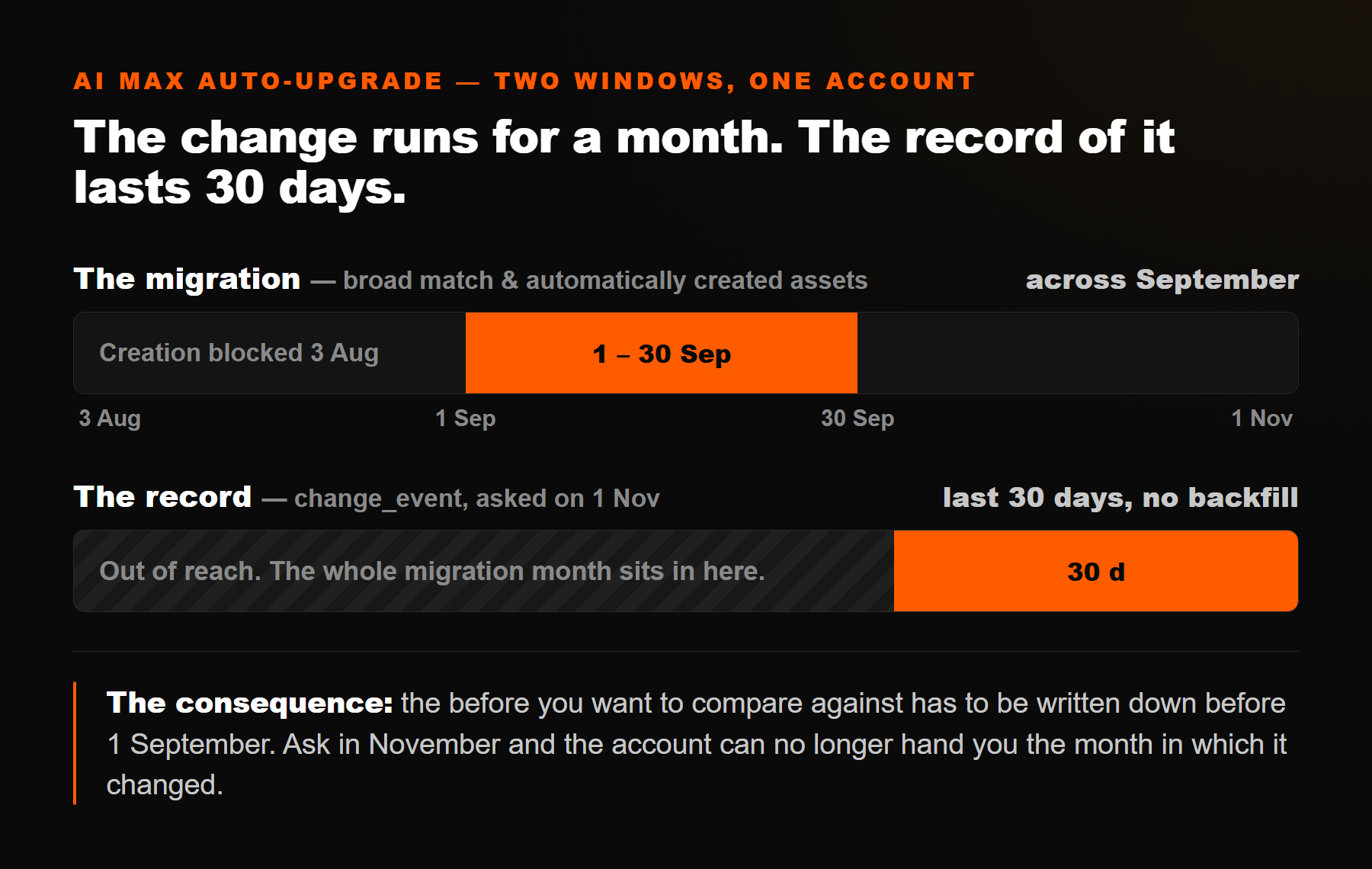
The change_event API returns the last 30 days and does not backfill. So the record of each migration expires roughly 30 days after it happened, campaign by campaign. One converted on 2 September falls out of reach around 2 October. The last of September's migrations is gone by the start of November.
The window is already closing, on a rolling basis, starting with the campaigns that moved first. Once a record has aged out it cannot be recovered.
- The list of campaigns carrying either setting. Names and IDs, in a file, dated. This is the inventory that can only shrink, and it is the one thing nobody will be able to reconstruct for you in October.
- A named baseline period, with exact dates. Not last month. Written as 1 to 31 August, so that a version of you in three months cannot quietly move it.
- The search terms pull with the match source segment. The query above. It is the only before that answers the question you will actually be asked.
- The decision rule, written before the number moves. What result would make you turn AI Max controls down, and what result would make you leave it alone. Decide it while you have no stake in the answer. The full version of that block is the charter in incrementality testing.
- The smallest change your account can read. If a campaign converts 20 times a month, most of what you will see in October is noise wearing a costume. The arithmetic is in what is a good ROAS.
That fourth one is the one people skip, and it is the one that decides whether any of this was worth doing. A rule written after you have seen the number is not a rule. It is a justification. That argument has its own page: you're deciding from memory.
On the record itself, the limit is specific and it is not new. The Google Ads interface keeps change history for two years. The API field that a tool or a script would read, change_event, returns the last 30 days and does not backfill. Whatever it holds about September is gone by early November. The detail is in Google Ads change history.
Doing all of that by hand is fine. If you run an agency and would rather your team saw what to look at first in one account, that is what the Paid Media Capacity Check is being built for.
Or see what your team should look at first: the Paid Media Capacity Check, being built nowI checked my own accounts. The answer was zero.
A zero is still a measurement, so here it is. None of the accounts I run carry either setting, and I did not have to go looking. The reason predates this migration.
I do not use automatically created assets. I do not hand auto-creation the part of the ad a client judges me on.
Broad match, and why I keep using it
Broad match I do use, and deliberately. When a term already performs in exact or phrase, I open it up to go hunting for longtail: new keywords, new ideas. It is an instrument I switch on and switch off. It is not a default setting I leave running.
That distinction is the one thing most people are about to get wrong, and it cuts both ways.
What the migration actually targets
The migration does not target broad match keywords. It targets the campaign-level broad match setting, which is a different object with a much bigger blast radius.
“Enabling this setting will convert all existing phrase and exact match keywords into broad match and ensure all keywords added also use broad match.”
Google Ads Help, About the broad match keywords campaign setting (retrieved 19 August 2026)
So if you run broad match the way I do, keyword by keyword, you may not be on the list at all. If you once flipped the campaign setting to run a test and left it on, you are on the list. Your exact and phrase keywords were converted the day you flipped it.
Which makes the affected set an odd shape. A discovery setting somebody turned on for a fortnight in March is about to become the permanent configuration of that campaign.
One thing that goes in Google’s favour
One last thing, and it goes in Google's favour, which is not a sentence I write often.
Google announced this one. There is a date, a developer post, an email on 5 August, and a lever you could still pull before September. Meta switches its AI on across your account and you find out later, if you find out at all.
You can dislike where this is going and still notice the difference in how you were told.
Or see what your team should look at first: the Paid Media Capacity Check, being built nowWhat this cost me to learn
In 2025 I spent more than 10,000 euros of my own money on ad management platforms. Not a client's budget. Mine.
What came back was the commentary Google and Meta already print inside their own interfaces, in a better-looking report. Not one of them ever told me the terms the numbers were computed under. Not one kept a record of the day the platform changed something underneath me.
Then I built the thing instead of buying it, and got taught the same lesson from the other side.
The first import, and what it returned
The first time I pulled change history into our own console it returned four identical rows. Same day, same wording, empty old and new values, HTTP 200 the whole way. The obvious diagnosis was stale data. The obvious diagnosis was wrong. The same campaign was arriving with two different references across imports, so the join silently returned nothing.
An empty record of what changed looks exactly like an account where nothing changed. That is the failure mode I care about, and September is the month it gets expensive.
The part I would not have believed until it happened: the day I most wanted to look at was the day I had not written down.
Or see what your team should look at first: the Paid Media Capacity Check, being built nowWhat I still do not know
- Whether removing the setting takes a campaign off the list. It was widely reported as the way out and it is the obvious reading. I have not found Google confirming it in writing, and I am not going to present an inference as documentation. For any campaign already converted, the question is now moot.
- Whether a converted campaign still shows what it used to carry. The configuration you can read today says AI Max. I would expect the previous state to survive only in change history, which is the record that expires. I have not been able to test it on an account of my own.
- Whether the migration writes a row in your change history. I would expect it to. I have not seen it confirmed, and it cannot be tested before the job runs. If it does not, the inventory you take this month is the only record that will ever exist.
- Which day your campaigns convert. Google publishes the month. It does not publish the schedule, and there is no reason to think you can request it.
- Whether the expansion behaves the same outside EMEA ecommerce. The 29% figure is one vendor's sample in one region and one vertical. I have no measurement of my own to put next to it yet.
And the honest objection, from the people this page is for. When Google announced a different dated change to bidding earlier this month, the most upvoted comment in the r/PPC thread about it was not a plan.
“I'm not sure why there's panic over this update. Set an ideal cpa/roas, let it run. Done.”
u/Different-Goose-8367, r/PPC, 4 August 2026, top comment of the thread with 24 votes. A second operator: “I'm personally on the side of not doing anything and seeing how it pans out”
Why that position is not lazy
That position is not lazy. It costs nothing, and it is right more often than the alternative, because most platform changes really do come out in the wash.
That position stops being right the day someone asks you what happened, and you have nothing to compare against. Taking an inventory now is cheap insurance against that one question. It is the only claim this page makes.
Related reading. Google Ads change history: why the record of what changed only reaches back thirty days. Marketing attribution: the four dials that move a number while the account stands still. What is a good ROAS: how to tell a real move from noise before you react to it. Marketing report template: where a platform change like this belongs in what you send the client.
Or see what your team should look at first: the Paid Media Capacity Check, being built nowWhat is changing in Google Ads on 1 September 2026?
Search campaigns still using campaign-level broad match or standalone automatically created assets are upgraded to AI Max. Google migrates them in place with equivalent settings, and existing brand inclusions and exclusions carry over. Dynamic Search Ads are not in this wave. They were moved to February 2027.
Can I opt out of the AI Max auto-upgrade?
Google has not published an opt-out. The migration is reported to target campaigns still carrying the legacy setting. Your levers are to stop using it, or to adopt AI Max yourself first and set the controls. I have not found Google confirming in writing that removing the setting takes a campaign off the list.
Does the migration happen on 1 September or across September?
Across September. The migration job rolls out progressively through the month, so a campaign that has not changed on 2 September may still change on 24 September. A September versus August comparison therefore mixes migrated and unmigrated days inside the same campaign.
How do I see which traffic came from AI Max?
Through the API rather than the interface. In search_term_view, the segments.search_term_match_source field separates AI_MAX_BROAD_MATCH and AI_MAX_KEYWORDLESS from ordinary matching. Google documentation also warns never to sum metrics across the AI Max views, because they overlap and privacy thresholds drop low-volume terms.
And the ones about your own account
If I use broad match keywords, am I affected?
Not necessarily. The migration targets the campaign-level broad match setting, not broad match as a keyword match type. Google states that enabling the campaign setting converts all existing phrase and exact match keywords into broad match, so it is a different object. Check which one your campaigns carry.
Which campaigns are affected by the September 2026 AI Max migration?
Search campaigns that still carry campaign-level broad match, standalone automatically created assets, or both. Creation of new configurations of either was blocked on 3 August 2026, across the interface, Google Ads Editor and all API versions. The affected set was closed before the notification emails went out.
What should I record before the AI Max migration runs?
The list of campaigns carrying either setting, a named baseline period with exact dates, and a search terms pull with the match source segment. Write the decision rule down before the numbers move. The change_event API reaches back 30 days, so a September switch is out of reach by November.
What settings do I get by default after the AI Max upgrade?
The defaults depend on which legacy setting the campaign carried. Both groups get search term matching on and final URL expansion off. Campaigns that carried standalone automatically created assets also get text customization opted in, so Google can rewrite headlines. Campaigns that carried campaign-level broad match get it opted out.
Can I still tell whether a campaign was migrated?
Only from the record, and the record expires. Once a campaign is upgraded, its current configuration says AI Max rather than what it carried before. The change_event API returns the last 30 days and does not backfill, so a campaign converted on 2 September falls out of reach around 2 October. The interface keeps change history for two years.
Has exact match stopped matching exactly?
Partly, in one measured sample. Smarter Ecommerce reported that about 29 percent of exact match impressions in EMEA ecommerce Search campaigns had been expanded by AI Max by July 2026, across 383 million impressions. They sell bid management software for ecommerce, so the direction is useful and the exact figure is theirs.
Last updated:
Or see what your team should look at first: the Paid Media Capacity Check, being built nowWho wrote this
I am Manu. I have been buying media for eight years, and I got tired of platforms changing something underneath an account without leaving a record of the day they did it. So I started building an open-source console that reads my Meta and Google data and never changes anything I have not approved. It is Apache-2.0, with a runnable demo on synthetic data. If you want the inventory above pulled on your own accounts while the record still reaches back, the audit below does exactly that and changes nothing.